What I Read This Month: June
No Surf Summer, half-remembered dreams, Dad Books Part Deux, Bigfoot

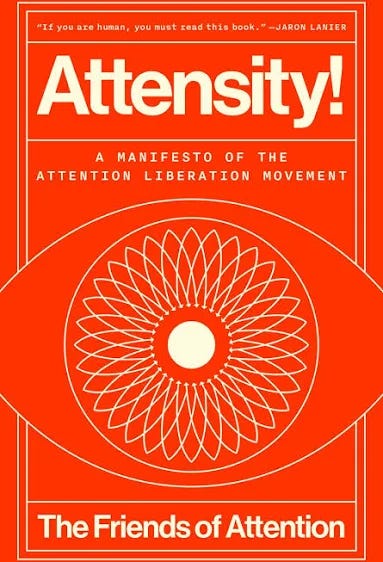
24. Attensity! A Manifesto of the Attention Liberation Movement, The Friends of Attention (2026)
A few springs ago—having spent enough of my children’s precious and few school hours ingesting such toxic online content that my beautiful mind felt indistinguishable from, roughly speaking, a mildewed shoebox filled with dead batteries, old cords, and sand of unknown provenance—I had an incredible idea. The idea was that I’d spend the summer off the internet. As of the summer solstice, I would not scroll, I would not click, I would not pick up a device at the incipient stirrings of boredom. I would lean into the boredom. Ride the boredom like a wave into some previous incarnation of self/summer: the summer I was nine, evading physical exertion at day camp by furiously creating a small colony of popsicle stick people; the summer I was eighteen, lovesick, whiling away bleak afternoons at my minimum wage movie theater job with a biography of Anne Sexton, feeling resplendently sorry for myself. All summers feel like half-remembered dreams, and yet, until recently, summer was the season in which I felt most feverishly, occasionally painfully, alive. Yes—here in the present I had more responsibilities, namely children to raise, but did that not make my mission more critical? Was it not essential for them to witness me aimless, staring into space, making zucchini bread, floating around the pool, getting improbably into baseball? Feeling the rain on my skin, etc.? In leaning into the boredom, could I transform not simply myself, but, potentially, the world? I called the concept No Surf Summer. (Get it?) I lasted about three days. Ensuing No Surf Summers have yielded identical, embarrassing results. The most demoralizing aspect is how perfect the three successful days typically are—salt in my hair, arts and crafts, thunderstorms, gin and tonics on the porch, movie nights. And then my lizard brain feels the slightest itch, and the dopamine slot machine in my pocket chimes its enchanting chime, and I can’t stop myself from pulling the lever, again and again and again.

I used to think this was a me problem—that I had undiagnosed ADHD or a medically significant dearth of will power. It doesn’t exactly comfort me to understand that it’s everyone. Normal people, too—this is what I can’t get over. I think about this post I saw when I probably should have been making zucchini bread: “The Internet was a beautiful thing for a while. It is now exclusively for people who are mentally ill. One might think that would make it a niche product, but it remains mainstream by making more and more people mentally ill.” You can clock the addiction of any number of ordinary high school classmates—people who spent their formative years socializing with one another at parties, versus, say, trawling the posts of lunatics on Bat Boy: The Musical message boards—by gauging the amount of Instagram stories they post in a day with the understanding that this most likely only scratches the surface of their screen time. Does it feel like a straight shot of poison to the brain to them? Is it possible they just don’t mind it? Yesterday, I caught the end of a conversation between two Boomers at the grocery store. “That’s why AI is the best!” exclaimed one man. “It certainly is!” the other agreed, waving goodbye. The fuck?
The Friends of Attention—the authors of this strange little book, a true manifesto by “a loose network of friends, collaborators, colleagues, and comrades”—assure me, in bright red font and plenty of italics and caps, that I am not alone. They call the widespread manipulation of our attention spans by tech corporations “human fracking” and persuasively argue that it’s time to do something about it. What it is I can or should do, I must admit, I find less clear. If you’re not already convinced that phones are bad, I’m not sure Attensity! will convince you—The Friends spend maybe too many pages trying to form a definition of “attention” that seems self-evident from the start, and in the end their call to action boils down to: Do you like to do something that’s not on a screen? Do it! (Friends, can’t you see me trying?) But in a world literally run by posters, a world where it feels socially acceptable to sit beside a cold pool on a hot day and ignore the water to tap tap tap at the slot machine, the repetition of The Friends’ assertion that “something is seriously wrong” really does feel reassuring:
We are in pain, suffering from a pandemic of loneliness and alienation and suspicion, trapped in impotent cycles of submission to…“ourselves” (to what seem to be our own reflexes and appetites, to our own enflamed anxieties and deformed aspirations), but in ways we know are, somehow, not who we actually are. This is the existential phenomenology of creatures who are literally being bio-hacked at a societal scale—and it feels terrible.
Good news, though: did you know many people say that summer doesn’t actually start until July 1st? I’m sure I’ve heard a lot of people say that.
24. “Risk, Discipline,” Andrew Martin (December 22, 2025 New Yorker)
25. “The Welfare State,” Nell Zink (December 29, 2025 & January 6, 2026 New Yorker)
Happy New Year!!!
26. “A Small Flame,” Yiyun Li (audio)
27. “Deal-Breaker,” Allegra Goodman (January 13, 2026 New Yorker)
28. “X-Acto,” Kate DiCamillo (March 21, 2024 One Story)
I loved this deceptively simple, deeply sad story by Kate DiCamillo, whose books for children arrived too close on the heels of my own childhood for me to enjoy at the time. “X-Acto” follows a little girl named Pen around a party she really shouldn’t be at in summer 1973. Perfect writing about children that’s not for children—mysterious, evocative, distressing. The author information on this two-year-old publication suggests DiCamillo is working on a story collection for adults; I send this out into the ether in the hopes that I can have it in my hands soon!
29. “Dear Margot,” Shira Zur,” (August 26, 2021 One Teen Story)
30. “From the Comfort of Your Own Home,” Lincoln Michel (June 23, 2022 One Story)
31. “Photoelectric,” Elane Kim (November 21, 2024 One Teen Story)
32. “Kim’s Game,” Sadia Shepard (January 19, 2026 New Yorker)
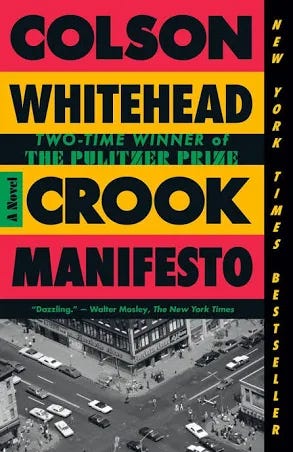
25. Crook Manifesto, Colson Whitehead (2023)
Too late for the corresponding holiday, but: do you personally have a Dad, or do you have a Dad in your life, or do you know a middle-aged man with a taste for Dad books, or a middle-aged woman with a taste for Dad books, other than me? If that individual isn’t already eagerly anticipating next month’s final installment of Colson Whitehead’s gorgeously written, seamlessly researched, ridiculously fun Harlem Trilogy, well—I don’t blame you, exactly, but it’s time to make it right.
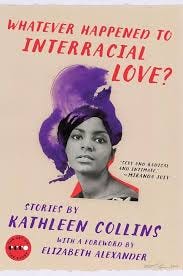
26. Whatever Happened to Interracial Love?, Kathleen Collins (2016)
Nabbed a copy of this story collection from a local Little Free Library a few years ago, around the time I watched Kathleen Collins’s 1982 film Losing Ground, and finally got around to it this month. The amount and quality of creative work that Collins generated in her tragically short life is so humbling it makes one feel one might as well be hacked—one is never going to accomplish that. Losing Ground is usually streaming on Criterion Channel and my memory of it is extremely fond if slightly hazy: golden sunlight, rental houses, marital friction. The stories Whatever Happened to Interracial Love? felt cinematic to me, too—sensual, fragmentary, unfolding in montage. A quick and occasionally transcendent read, with a couple of knockouts, including the title story and “Dead Memories…Dead Dreams.”
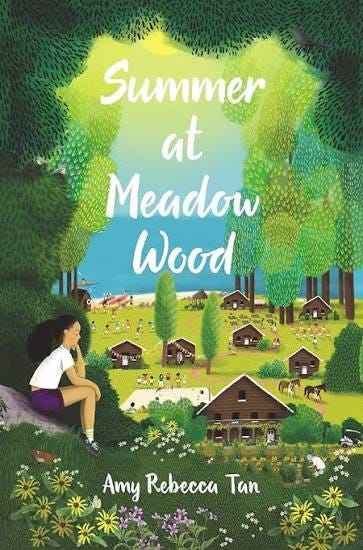
27. Summer at Meadow Wood, Amy Rebecca Tan (2020)
Another sweet, intensely readable middle-grade novel by Tan, whose books my daughter and I both recently gobbled up like candy. Vic, the protagonist of Summer at Meadow Wood, is the best friend of Jamie, who we read about in A Kind of Paradise; their stories take place over the course of the same summer but don’t intersect beside the two of them missing each other. I love how Tan evokes setting, in this case a sleepaway camp in New Hampshire—its heat, lake, trails, and cabins feel like visions from my own half-remembered summers, even if the only camp I ever went to was at a rec center half a mile from my childhood home, with its lax rules, infinite supply of popsicle sticks, and at least one teen boy counselor who welcomed shoulder massages from the tween girl campers, Jesus Christ, time to half-forget that.
Last week, my daughter got a pixie cut. Sunday afternoon, we dropped her off at her first sleepaway camp. For the rest of the week she lives about forty minutes away from us, amidst a group of total strangers. An adventure not entirely influenced by Summer at Meadow Wood, but not not influenced by it. How is she doing? I don’t know; that’s the point! How am I doing? Well, crying a lot. Checking the weather obsessively. Have written her four letters in three days. Last night I found myself reading a blog post about “kidsickness” at 2 a.m. Scanning the camp bulletins for glimpses of the back of her head. Like she’s Bigfoot. How is it possible to have birthed a creature so much braver than myself? So feverishly, sometimes painfully, alive? She wants a phone, of course; she’s a child of the twenty-first century who begged us to keep her Duolingo streak going while she was gone, but for now she’s riding the summer like a wave into a new incarnation of self. Pure, brilliant, and not yet bio-hacked. Giving it all her unvarnished attention: this dream that one day she’ll half-remember.
🚨🚨🚨Town Pool Reading Report🚨🚨🚨
For this and the next two months I’d like to highlight the brave attention activists I spot reading actual physical books at the town pool. Carry on, noble warriors! Many apologies for squinting in your direction for what must have felt like uncomfortable lengths of time:
The Housemaid’s Secret, Freida McFadden
The Housemaid’s Secret, Freida McFadden (again)
The Intern, Michele Campbell
The Astral Library, Kate Quinn
Harry Potter and the Deathly Hallows
Dancing Bear, James Crumley (this one was my husband)
Dungeon Crawl Carl, Matt Dinniman
Ring the Bell: How the Philadelphia Phillies Built Baseball’s Best Fan Base, Kevin Reavy and Jack Fritz
Team of Teams: New Rules of Engagement for a Complex World, General Stanley McChrystal
KT, wish I went to your pool. That sounded less creepy in my head.
I'm looking forward to the last Colson Whitehead to come out b/c it seems fun to read them back to back to back!